Four Steps Before You Act
Save or share this quick reminder when a suspicious text arrives.
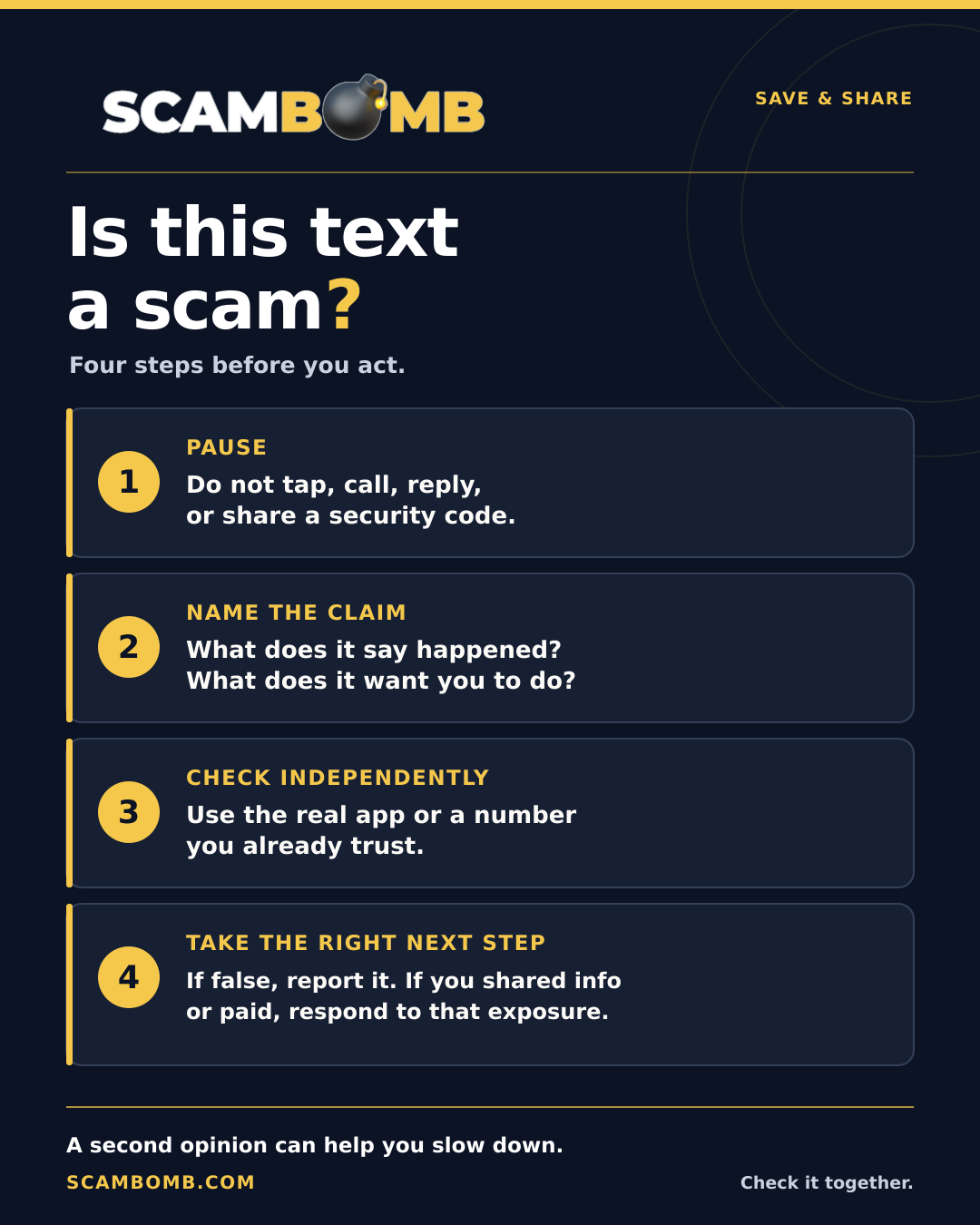 Open the shareable image
Save or share this quick reminder when a suspicious text arrives.
Open the shareable image
Quick-Reference Checklist
Keep this one page handy. Most scams follow the same playbook: an unexpected message, a reason to hurry, and a request for money or personal information. When a suspicious text or email arrives, run it through the five questions below. If you answer "no" to even one, stop — it's almost certainly a scam. Print this sheet, stick it on the fridge or by a parent's phone, and use it as the shared family rule before anyone clicks, calls, or pays.
Why a checklist works. Scammers don't rely on you being careless — they rely on you being rushed. A written list gives you something to slow down with, and it gives older family members a script they can follow without needing to be tech experts. The five questions on the next card take about ten seconds to run, and any single "no" is your cue to stop and verify another way.
| # | Ask yourself | Red flag |
|---|---|---|
| 1 | Did I expect this message? | Surprise delivery, bank alert, job offer, or refund. |
| 2 | Does it create urgency or fear? | “Act now,” suspension threats, penalties, or benefits expiring. |
| 3 | Does it ask me to click or call? | Links or phone numbers supplied inside the message. |
| 4 | Is the sender slightly off? | Lookalike domain, random number, or misspelled company name. |
| 5 | Does it ask for money or personal information? | Password, PIN, SSN, gift cards, crypto, wire transfer, or remote access. |
Hover over links on a computer without clicking. On a phone, don’t tap at all. Watch for shortened URLs, extra characters, and lookalike domains such as USPS-delivery.net instead of USPS.com.
There’s a problem with your delivery and a link to “fix” it. USPS does not send unsolicited texts with links or charge redelivery fees.
Easy money, no experience needed, reply now. The “job” eventually asks for an equipment fee, training deposit, or money transfer.
“Did you make this purchase?” Replying confirms your number is active. Real banks never ask you to move money to a safe account.
A small balance and urgent payment link lead to a fake page that steals your card number. Log in to your toll account directly.
A friendly stranger keeps chatting and eventually pitches an investment. No stranger who texts you by mistake needs to become your friend. Block and delete.
The bottom line. Real companies give you time to think; scammers try to steal it. Whether the message claims to be from a bank, a delivery service, a toll agency, or a family member, the answer is the same: stop, verify through a number or website you looked up yourself, and never pay or share a code under pressure. When in doubt, use this checklist before you click, call, or reply — and teach someone you love to do the same.
| Agency | Real number / website | What they never do |
|---|---|---|
| USPS | 1-800-222-1811 USPS.com | Send unsolicited texts with links or charge redelivery fees. |
| IRS | IRS.gov 1-800-829-1040 | Demand immediate payment or ask for gift cards. |
| Social Security | 1-800-772-1213 SSA.gov | Suspend your SSN or demand payment over the phone. |
| Your Bank | The number on your card | Ask for your full SSN or password by text. |
Keep this guide somewhere easy to find when a suspicious message arrives.
For reprint or commercial licensing, contact [email protected].